How to Find a Niche for Print on Demand: The 3-Step Automated Way
Entering the print-on-demand space without a clear data strategy is like sailing without a compass. The US and UK marketplaces are highly rewarding, but they are also crowded with sellers targeting the exact same generic keywords.
If you want to build a sustainable digital storefront, you need to learn how to find a niche for print on demand that has high buying intent but low design saturation.
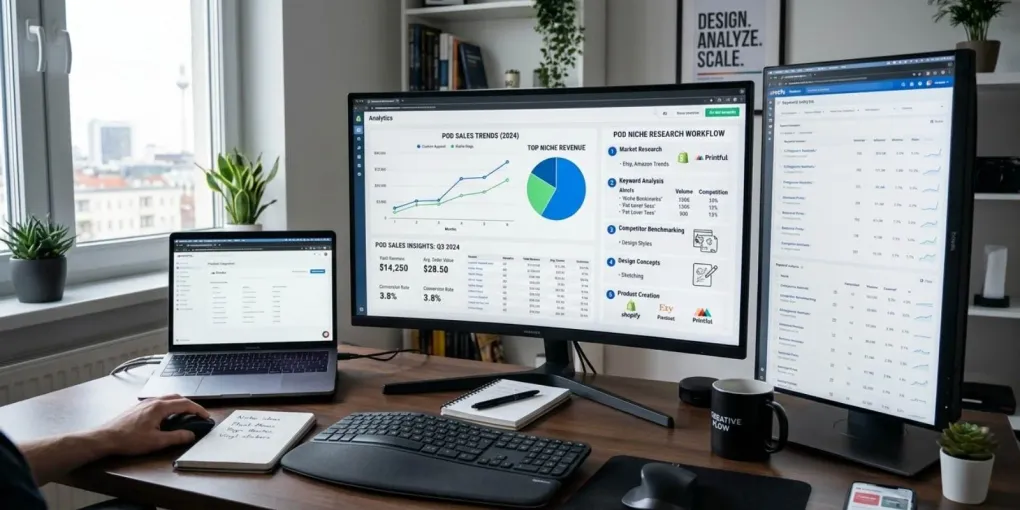
The old method of manually scrolling through hundreds of Amazon listings or checking Etsy autocomplete tags is dead. It drains your energy and wastes valuable upload slots on dead concepts. Instead, professional creators rely on automated workflows. Here is the exact 3-step automated framework to discover untapped opportunities in minutes.
Step 1: Filter Marketplaces by Sales Velocity (BSR)
The quickest way to validate if a niche is worth your time is to check if people are already spending money on it. In the Amazon ecosystem, this is measured by the Best Sellers Rank (BSR).
Instead of looking at random search terms, an automated strategy flips the script:
- You log into a specialized research tool or database.
- You set your filters to display products within a specific BSR window (e.g., between 50,000 and 150,000 for apparel).
- The system automatically surfaces hidden cross-sections like librarians who love tabletop role-playing games or vintage botanical woodcut art enthusiasts that are actively generating royalties.
By focusing purely on active velocity, you eliminate guesswork entirely.
Step 2: Extract and Analyze Keyword Clusters for How to Find a Niche for Print on Demand
Once you uncover a sub-niche with strong sales, you must understand the exact language buyers use to find those products. This is where advanced tag analytics come into play.
When analyzing listings, look closely at the metadata of top performers. Your automated tool should allow you to isolate high-volume tags and check search trends. This ensures the phrase isn’t just a 48-hour social media flash in the pan, but a steady, sustainable trend.
Map semantic layouts to group related keywords together. This lets you write professional, narrative-driven product descriptions rather than messy, spammy tag lists. Remember that platforms like Redbubble enforce a strict maximum of 15 tags per listing; exceeding this triggers spam penalties and suppresses visibility.
Step 3: Verify Trademark Safety in One Click
Finding a profitable niche means nothing if your merchant account gets suspended. The biggest pitfall when researching niches for the US/UK markets is accidentally stepping on registered trademarks.
Manual trademark databases are slow and tedious to cross-reference. A modern automated workflow handles this instantly. Before you commit to creating designs, run your gathered keyword list through an automated safety filter. If a phrase is flagged, discard it immediately and pivot to a safe variation.
The Ultimate Weapon for POD Automation
Executing this 3-step framework manually takes hours of copying and pasting data into spreadsheets. To truly scale your business, you need a software setup that compresses this process into seconds.
This is where a dedicated platform like Podly completely alters your workflowcompletely changes your workflow. It acts as a lightning-fast data pipeline that monitors live Amazon Merch metrics, handles KDP tracking, and protects your account with built-in trademark analysis.
If you want to see exactly how this tool handles the heavy lifting for your store, make sure to check out our deep-dive Podly Review & Strategy Guide where we break down its interface and show you how to maximize your ROI.
Summary Checklist for Fast Niche Validation
Before you open your graphic design software, run your discovered niches through this quick checklist:
- Proven Sales: Are there at least 3 or 4 designs in this sub-niche with a stable, active BSR?
- Low Saturation: Is the total search result count low enough for a brand-new listing to rank on page one?
- Trademark Clean: Have you checked both the title and the secondary search phrases for active corporate filings?
- Print Ready: Is the concept optimized for manufacturing constraints, keeping chest graphics centered above any pocket and away from seams or sleeves?
Frequently asked questions
How do beginners find print on demand niches?
Beginners often search manually, but the most efficient way is to use data automation tools that filter products by Best Sellers Rank to instantly identify buying intent.
What is a good BSR for Amazon Merch niche research?
A lower BSR indicates higher sales velocity. Finding sub-niches where multiple shirts have a stable BSR under 200,000 is a strong signal of a profitable niche.
How many tags should I use on Redbubble listings?
Redbubble enforces a strict maximum of 15 tags per listing. Exceeding this limit triggers spam penalties and suppresses your visibility in search results.
How do I ensure chest graphics look professional on apparel mockups?
Keep apparel graphics compact and centered high on the chest. This spacing avoids seams, pockets, and sleeves during industrial batch printing.
More from this series
Tools mentioned in this guide