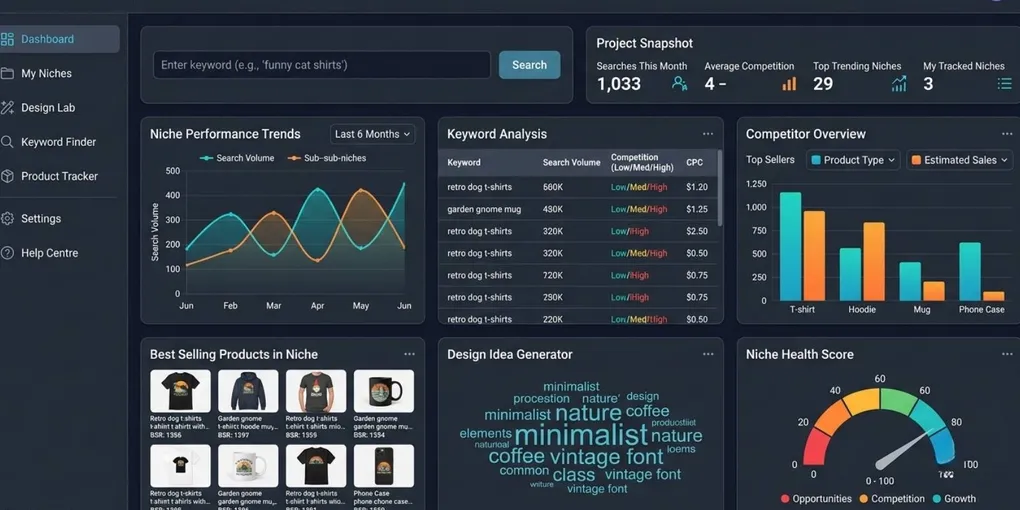
Podly Analysis: What It Actually Fixes (And What It Doesn't)
Here’s the scene, and if you sell print-on-demand you’ve probably lived it: it’s 11 p.m., you have four Etsy tabs open, a spreadsheet with four abandoned columns, and a growing suspicion that the “hidden niche” you found twenty minutes ago already has 40,000 listings. You close the laptop no closer to an answer than when you opened it.
That’s the actual problem a tool like Podly is supposed to solve. Not “finding niches” in the abstract stopping that specific 11 p.m. spiral.
We Didn’t Buy It. Here’s What the Evidence Can Tell Us.
Most Podly articles online were written by someone who signed up for one afternoon, clicked around, and wrote 1,500 words based on a single session often with an affiliate link waiting at the bottom. We didn’t do that either, but for a different reason: one afternoon with a research tool tells you almost nothing about whether its trend data holds up over a real selling cycle.
Instead, we did the less glamorous thing we read through seller threads, comparison posts, and public feedback across the POD community over several weeks, cross-checking where people agreed and where they clearly didn’t. That’s not the same as running the tool ourselves, and we’re not going to pretend it is. What it does give you is something a single test run can’t: where the actual disagreements are, not just one person’s first impression.
What Sellers Actually Confirm Podly Gets Right
Strip away the marketing copy and three claims show up repeatedly, from unrelated sellers, in unrelated threads:
- The BSR filtering saves real time. Multiple sellers describe the same before/after: manually cross-referencing Best Sellers Rank across categories used to eat a chunk of a Sunday afternoon. Filtering directly for the BSR range that indicates “actually selling, not just listed” gets described as the single feature people keep paying for.
- The interface doesn’t fight you. This comes up specifically in comparisons with Merch Informer, an older tool in the same space. People who switched describe less friction, not more accurate data that distinction matters, and we’re not going to blur it.
- Keyword clustering shortens the guessing phase. Grouping related search terms so you’re not manually building a metadata list from scratch is the second most-mentioned time-saver.
None of that is dramatic. It’s the boring, unglamorous kind of useful which, in our experience, is usually the sign a tool’s claims are actually holding up.
Where the Story Gets Less Clean
This is the part most reviews skip, because it doesn’t help sell anything.
Trademark filtering catches the obvious, not the risky. It screens out clearly protected terms useful, but it’s a floor, not a safety net. Anything ambiguous still needs a real check. If you’re about to commit to a design around a phrase you’re not 100% sure about, run it through the USPTO trademark database yourself before you list it. That’s five minutes that a $30 filter can’t replace.
“Real-time” trend tracking has real limits. Several sellers note that by the time a trend is visible in the data at all, a meaningfully sized chunk of the market has already reacted. The tool shortens your reaction time; it doesn’t hand you a crystal ball. Treat velocity spikes as “worth investigating today” signals, not guarantees.
Search volume estimates are directional, not exact. This is true of every tool in this category, not just Podly, but it’s worth saying plainly: treat the numbers as “bigger or smaller than that other term,” not as a number you’d put in a business plan.
Who This Actually Makes Sense For
If you’re managing a growing catalog say 50+ live designs and niche research has become a recurring weekly task rather than an occasional one, the time saved on BSR filtering and keyword clustering will likely justify the subscription within the first month.
If you’re just starting out with a handful of designs, we’d hold off. The tool is built to speed up a process you repeat often. If you’re not repeating it often yet, you’re paying to speed up something you barely do.
For readers building out a broader keyword and tagging strategy rather than just niche selection, our breakdown of how to find print-on-demand niches and the deeper print-on-demand niche research guide cover the manual version of this process worth reading even if you end up automating parts of it. And if tag structure specifically is your bottleneck rather than niche discovery, our Redbubble tag hierarchy system tackles that half of the problem.
What Nobody Agrees On
Not everything sorted neatly into “confirmed” or “debunked.” A few points split sellers right down the middle, and we’d rather flag the disagreement than paper over it.
Pricing tolerance is one. Some sellers with large catalogs call Podly’s subscription “invisible” next to what they save in hours; others running smaller shops describe it as the first tool they cut when trimming their monthly software list. Both groups are describing the same price they just weigh their own time differently, and that’s genuinely a “know your own numbers” situation, not something a review can settle for you.
Trend-chasing itself is the second split. Part of the seller community treats fast-moving trend data as the whole point of a tool like this. Another part argues that reacting to trend spikes just puts you in a race you’re unlikely to win against sellers with bigger production pipelines, and that the BSR and keyword features matter more than the trend tracker ever will. We lean toward the second camp, but we’ll say plainly: that’s a judgment call, not a fact we verified.
If You Try It Anyway
A few things worth doing regardless of which side of that debate you land on: start with a single sub-niche you already have some traction in, rather than a blank search. Use the BSR filter to confirm what you suspect is working before you use it to go hunting for something new it’s a better first test than starting cold. And keep the USPTO check as a habit for anything past the first pass, not a one-time step you do once and forget.
None of that requires the subscription to be perfect. It just requires you to know what you’re actually paying it to do.
The Honest Verdict
Podly does the specific job it claims to do it just doesn’t do the job some of its own marketing implies. It won’t find you a guaranteed winning niche, and it won’t replace an actual trademark search. What it reliably does is compress a genuinely tedious research process into something that takes minutes instead of hours, for sellers who are already doing that research often enough for the time savings to matter.
That’s a real, if unglamorous, reason to consider it. It’s also a good reason to skip it if your catalog isn’t there yet.
If you’re past the point where manual research is eating your week, you can get Podly here. Just keep the caveats above in mind before you commit.
Some links in this article are affiliate links. We don’t personally purchase or test every tool we cover our recommendations are built from pricing pages, official documentation, and aggregated user feedback across the POD community, cross-checked for consistency before we write anything down.
Frequently asked questions
What is Podly used for?
Podly is a research tool for Amazon Merch and KDP sellers. It tracks Best Sellers Rank movement, estimates keyword search volume, and flags terms that look trademark-risky before you list a design.
Is Podly better than Merch Informer?
It depends what you're optimizing for. Sellers switching from Merch Informer consistently mention a faster, less cluttered interface. Nobody we found claims Podly's underlying data is more accurate just easier to act on.
Does Podly actually prevent trademark strikes?
It flags known protected terms, which catches the obvious mistakes. It cannot replace a real trademark search for anything borderline see the USPTO link below if you're unsure about a specific term.
Is Podly worth it for a beginner with under 20 designs?
Probably not yet. The pricing only pays for itself once niche research is eating hours of your week which usually means you already have some catalog and sales data to react to.
More from this series
Tools mentioned in this guide