How Pinterest's Visual Search Engine Works for POD (2026)
Digital marketers often make the mistake of grouping Pinterest with traditional social networks like Instagram or TikTok. They build content strategies around vanity metrics like likes, comments, and follower counts.
The old social playbook is dead. Pinterest operates entirely as a Visual Search Engine and Discovery Graph.
Users do not visit the platform to passively scroll. They open the application with active commercial intent to plan projects, optimize workflows, discover design assets, or find software platforms to scale their enterprises.
To tap into this high-intent stream of organic traffic, you must think like a technical SEO. Optimizing your digital assets requires a deep understanding of how Pinterest’s visual extraction algorithms process upload data.
For a complete overview of Pinterest strategy for Etsy sellers, check our Pinterest SEO guide for Etsy.
1. Computer Vision and Pixel Extraction
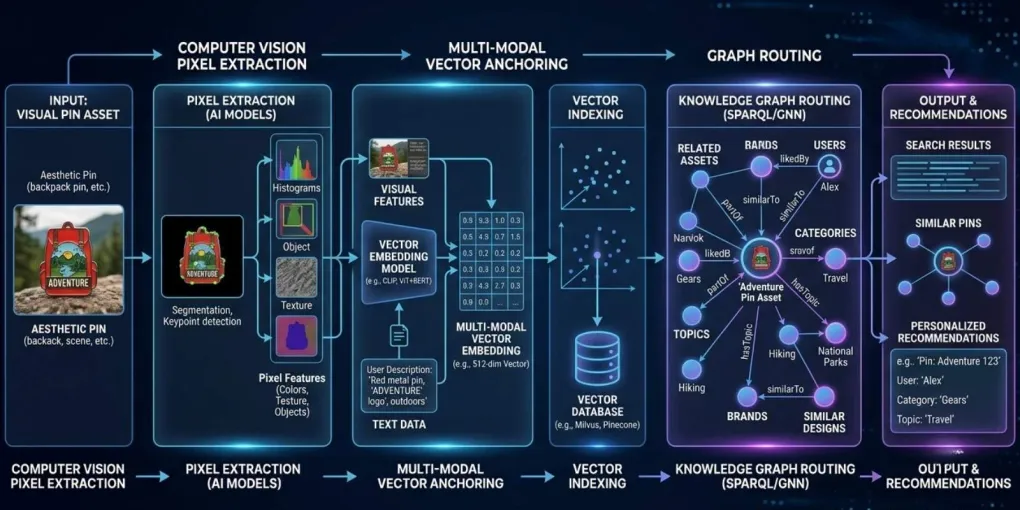
When you upload a new visual pin, Pinterest’s artificial intelligence scans the image using advanced computer vision neural networks running on custom cloud silicon. The algorithm breaks down your image into multi-dimensional vectors, analyzing three specific layers:
- Object Segmentation: Identifying exact shapes, silhouettes, interface components, and text overlays within the graphic boundaries.
- Color Palette Anchoring: Mapping dominant color values to cross-reference them with visual trend aesthetics tracking across global user data.
- Template Duplication Audits: Checking the core structural layout of your graphic against millions of existing assets in its index.
What This Means for POD Sellers
- Text overlays are critical they help the algorithm understand what the product is.
- High contrast colors (e.g., black text on white background) are easier for computer vision to parse.
- Unique layouts (different crops, angles, backgrounds) help avoid duplication flags.
For a deeper dive on optimizing visuals for Pinterest, read our Pinterest SEO and AI Mockups guide.
The Saturated Template Trap
If the visual AI detects that your graphic shares a pixel-by-pixel match with thousands of identical, low-effort template backgrounds a major issue plaguing print-on-demand mockups the algorithm flags the asset as low-quality. It restricts feed distribution to prevent user fatigue. High-volume upload pipelines must avoid overlapping layout configurations to bypass this automated filter.
How to avoid it:
| Risk Factor | Safe Alternative |
|---|---|
| Identical flat-lay mockup | Lifestyle image (product in context) |
| Generic white background | Colored or textured background |
| No text overlay | 2-4 word overlay (e.g., “Dark Academia Tee”) |
| Same crop as everyone else | Different crop or zoom level |
2. The Mechanics of the “Fresh Pin” Boost
Because Pinterest prioritizes high-quality user engagement, the routing engine prioritizes raw novelty. This has formalized into a core algorithmic mechanism known as the Fresh Pin Reward.
A “Fresh Pin” is defined strictly as an asset utilizing a visual image combination that the platform’s index has never seen before.
The algorithm gives these new graphics an immediate algorithmic injection into search results and home feeds to test user engagement metrics like close-ups, saves, and outbound link clicks. If your asset relies on recycled imagery, it skips this initial distribution window entirely.
The Fresh Pin Strategy for POD
- Create 3-5 different pin designs for each Etsy listing.
- Change the background, crop, or text overlay for each variation.
- Schedule pins using Tailwind or Pinterest Scheduler to maintain consistency.
- Repin older pins only after 30 days and always add a new description or title variation.
For a detailed breakdown of Pinterest’s algorithm and the fresh pin strategy, read our Pinterest Algorithm guide.
3. Multi-Modal Search and the Commerce Graph
The platform uses multi-modal AI frameworks to connect visual data directly with user text queries. This engine parses explicit visual components and marries them with metadata attributes to understand exact context.
- Text and Visual Context Intersect: The algorithm processes the text overlay inside the image, your pin title, description keywords, and the structured data of the linked URL to build a comprehensive contextual map.
- The Taste Graph Link: Once the AI indexes the image vectors and text data, it routes the pin into specific clusters within the Taste Graph. This matches the pin to users who have shown historical interest in similar visual styles.
Practical Takeaways for POD
| Element | What to Optimize |
|---|---|
| Pin title | Include your primary keyword (e.g., “Dark Academia T-Shirt”) |
| Pin description | 150-250 characters with natural keyword placement |
| Text overlay | Reinforce the metadata (e.g., “Dark Academia Gothic Tee”) |
| Linked URL | Ensure the Etsy listing has complete metadata and Rich Pins enabled |
For e-commerce and B2B SaaS platforms, this means your asset styling must be highly intentional. A confusing mockup or a heavily filtered graphic misleads the computer vision engine, causing it to categorize your pin under an irrelevant search demographic.
For more on cross-platform storytelling, read our Tumblr storytelling guide.
Summary: Optimizing for the Visual Index
To win on Pinterest, treat every pin like a landing page for an algorithmic crawler.
| Rule | Why |
|---|---|
| Design unique layouts | Avoid the saturated template trap |
| Use clear text overlays | Reinforce your metadata keywords |
| Upload fresh assets consistently | Trigger the Fresh Pin Reward |
| Enable Rich Pins | Pull real-time metadata from your Etsy listings |
| Track outbound clicks | Measure what actually drives traffic |
By feeding the computer vision engine clean, recognizable visual data, you ensure your software or products surface directly in front of buyers at the exact moment of high-intent search.
For a complete workflow on tracking Pinterest ROI, read our Pinterest Analytics guide once it’s published.
Frequently asked questions
What is a 'fresh pin' on Pinterest and why does it matter?
A 'fresh pin' is a pin with a visual image combination that Pinterest's index has never seen before. Pinterest gives fresh pins an immediate algorithmic boost to test user engagement. Recycled images skip this initial distribution window, making fresh pins essential for organic reach.
How does Pinterest's visual search engine work for product images?
Pinterest uses computer vision to analyze object segmentation, color palettes, and layout structures. It then matches these visual vectors against user search queries and the Taste Graph. For POD sellers, this means unique, high-contrast mockups with clear text overlays perform significantly better than generic flat-lay templates.
Why are my pins not getting views on Pinterest?
Common reasons include: using saturated templates (identical to thousands of other pins), missing text overlays that provide context, poor image quality, or inconsistent posting. Pinterest rewards unique visuals and regular fresh content. If your pin is flagged as a duplicate, it won't receive the 'fresh pin' boost.
How often should I post fresh pins for my POD products?
3-5 fresh pins per week per product is the recommended sweet spot. Pinterest rewards consistency over volume. For each Etsy listing, create 3-5 different pin designs (different crops, text overlays, or backgrounds) to test what resonates with your audience without triggering duplication filters.
More from this series