How to Build a Data-Informed POD Buyer Persona
A useful POD buyer persona is not a demographic label or a hashtag. It is a short, revisable evidence log: the search terms buyers use, the problem or occasion that triggers a purchase, the visual cues they respond to, and the observations that support each decision. This guide shows how to turn Etsy Stats, buyer feedback and visual research into a persona you can actually use for mockups, listing copy and pricing tests.
Why Most POD Sellers Guess Their Audience Wrong
The guessing happens because building a real persona feels like it belongs in a marketing textbook, not a Tuesday afternoon between design batches. So sellers default to describing their audience by aesthetic — “gothic,” “cottagecore,” “TTRPG fans” — and stop there. The aesthetic describes the products, not the person buying them.
Two buyers can want the exact same gothic-styled mug for completely different reasons: one is furnishing a themed apartment and cares about how it photographs on a shelf, the other is buying a gift for a friend and cares about how fast it ships before a birthday. Same aesthetic, different purchase triggers, different listing copy that would actually convert each of them. Guessing at “the audience” collapses both people into one imaginary buyer who satisfies neither.
This matters more than it sounds, because choosing the wrong niche in the first place is usually a symptom of the same root problem — sellers pick a visual theme they personally like, then work backward to invent an audience for it, instead of starting from evidence that real buyers already exist and want something specific.
Research Methods: Etsy Search, Pinterest Trends, Reddit
You don’t need a market research budget to do this properly. Three free sources, used together, get you most of the way there.
Etsy’s own search and Stats tabs are the most direct signal you have. The Stats tab under your shop dashboard shows the literal search terms that brought visitors to your listings — not what you assumed people would type, but what they actually typed. If “gothic mug for dark academia decor” consistently outperforms “gothic mug gift,” that’s telling you your current buyers skew toward self-purchase and home aesthetic, not gift-giving, whatever your original assumption was.
Pinterest saves, boards and comments can add qualitative context that Etsy search cannot. Someone saving “dark academia study aesthetic” is usually collecting visual references rather than making an immediate purchase decision. Treat this as an interest signal, not as a market-size forecast: record what visual themes repeat, then test those observations against the search terms, favourites and orders in your own shop.
Niche subreddits and Facebook groups give you something neither platform does well: buyers’ vocabulary, in their own words and outside a search box. A subreddit for TTRPG players can use different terms for the same concept than your listing copy does. Use that language to form hypotheses, then validate it against your shop data rather than treating a small community as a representative sample. Etsy’s market research guidance similarly recommends combining Stats, reviews, customer conversations, social behaviour and secondary sources instead of relying on one signal.
If manually cross-referencing these three sources across a growing catalog gets unwieldy, this is exactly the kind of pattern-spotting a tool like Podly is built to speed up — see our honest breakdown of what it actually fixes before deciding if it’s worth adding to your workflow.
Building Your Buyer Persona (Template)
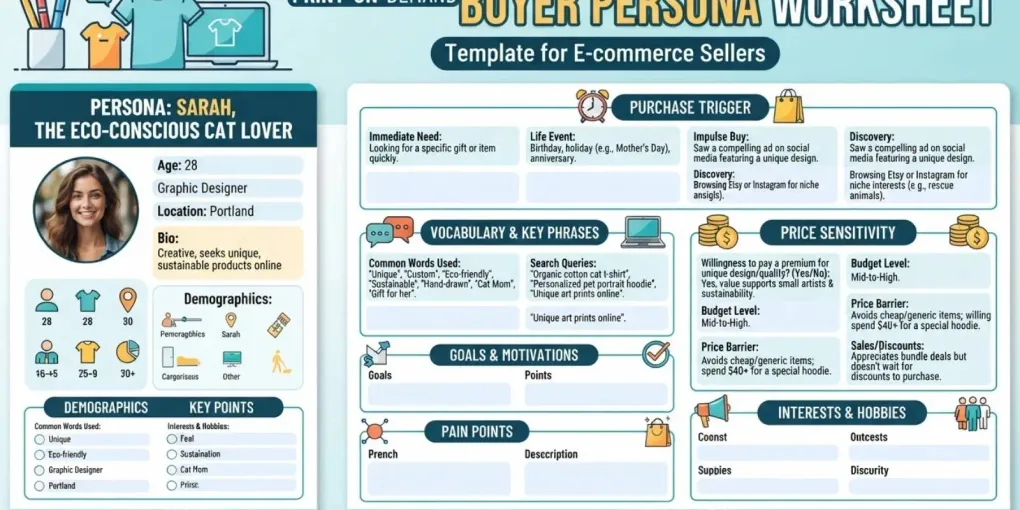
A usable persona doesn’t need to be elaborate. It needs four things, all pulled from the research above rather than invented:
- Purchase trigger: What specifically prompts this person to buy right now? (Gift deadline, home refresh, personal milestone, fandom release)
- Vocabulary: The 3-5 exact phrases they use to describe what they want, pulled from your Stats tab and Reddit/forum language.
- Price sensitivity hypothesis: What evidence suggests a buyer compares alternatives, waits for a discount or values speed and convenience? Validate this through listing variants, favourites, carts, orders and customer questions; do not infer it from one timing metric.
- Where they discover you: Etsy search, Pinterest, or direct/repeat — each implies a different first impression your listing photos need to make.
Write this as three or four sentences, not a corporate slide. Etsy’s own guidance on defining your target customer makes the same point: the goal is a realistic person you can picture making the decision, not an abstract demographic bracket.
Keep an Evidence Log Before You Design
Before turning research into a persona, record each observation in one small table: the source, the exact wording or behaviour you observed, the hypothesis it creates, and the listing decision you will test. For example, a repeated question about gift delivery can justify testing a clearer dispatch message; it does not prove that every buyer is price-insensitive. This distinction prevents a persona from turning into a story you keep repeating after the evidence changes.
| Source | Observation | Hypothesis | Testable decision |
|---|---|---|---|
| Etsy Traffic Stats | A specific search term sends qualified visits | The buyer describes the need with that phrase | Use the phrase naturally in a title, tag and image alt text |
| Customer message or review | Buyers mention a deadline or use case | Speed or gifting may matter | Test an explicit dispatch or gift-oriented image message |
| Pinterest board or save pattern | Similar colour, room or motif repeats | A visual direction may resonate | Build one mockup set and compare engagement |
Mapping Persona to Design Decisions
Once the persona is written down, it should actively constrain your next design batch, not just sit in a notes app. If your research shows your buyer is furnishing a themed space and photographs their purchases for a personal aesthetic feed, your mockups need to show the product in that kind of styled context — not a flat product shot on white. If your buyer is a last-minute gift-giver, your listing photos need to sell the unboxing moment, since that’s the part they’re picturing when they hit buy.
This is the same logic covered in building a cohesive visual niche: a strict, consistent design language only works because it’s aimed at a specific person’s taste, not because consistency is a virtue on its own. Skip the persona step and “consistent branding” becomes consistent guessing.
Mapping Persona to Pricing Strategy
Price sensitivity is where sellers most often ignore their own persona research and default to copying a competitor’s price instead. A buyer with a short search-to-purchase window and a clear gift deadline is far less likely to abandon cart over a $3 difference than a buyer who’s been saving reference boards for weeks and is comparing five shops side by side.
This connects directly to the margin math covered in Printful’s own profitability guidance: a healthy net margin depends on pricing with intent, not on matching whatever number a competitor listed. Knowing which type of buyer you’re actually attracting tells you how much room you realistically have to price above the cheapest option in your niche, without needing to guess and hope.
Worked Example: Generic to Niche-Targeted Store
A useful way to see this play out is to picture two versions of the same gothic-themed POD shop. This is an illustrative scenario, not a measured SaaS Select case study. The generic version lists “gothic aesthetic” apparel and home goods broadly, with listing copy describing the visual style and little else. The niche-targeted version uses the research steps above to test whether its buyers split into two groups — dark academia home decor shoppers furnishing a specific aesthetic, and TTRPG players buying character-inspired merchandise for game nights.
Once that split is visible, the fix isn’t a redesign — it’s separating the listing copy, mockup styling, and even board strategy on Pinterest by persona instead of treating “gothic” as one audience. Home decor listings shift toward styled, in-context mockups and vocabulary like “aesthetic” and “collection.” TTRPG listings shift toward character and campaign language pulled straight from the relevant subreddits. Same underlying designs, two distinct buyers finally being spoken to directly instead of both being spoken to vaguely.
Conclusion
A buyer persona is not a branding exercise — it is a working research note that makes downstream decisions easier, from mockup style to listing language and pricing tests. The starting evidence can come from Etsy Stats, customer feedback and visual research; the discipline is recording what you observed, testing the decision it suggests and revising the persona when the evidence changes. For the visual execution, connect this work to your colour strategy and lifestyle mockup workflow rather than treating the persona as a standalone document.
Frequently asked questions
What is a buyer persona and why do I need one?
A buyer persona is a working profile of the person most likely to buy from your shop, built from actual search and purchase data rather than assumptions. Without one, every design and pricing decision is a guess repeated across hundreds of listings.
How do I research my POD niche audience?
Start with Etsy's own search and Stats tabs, cross-reference with Pinterest trend data for the same keywords, and check niche-specific subreddits or Facebook groups where your buyers already discuss the topic in their own words.
Can I use Etsy search data to understand my buyers?
Yes, and it's the most direct source you have. Your shop's Stats tab shows the exact search terms bringing in traffic, which tells you the vocabulary and intent of real buyers rather than the vocabulary you assumed they'd use.
How does my persona affect my design choices?
A defined persona narrows your color palettes, typography, and phrasing to what that specific buyer responds to, instead of designing for a generic 'everyone' audience that ultimately resonates with no one strongly enough to convert.
More from this series
Tools mentioned in this guide