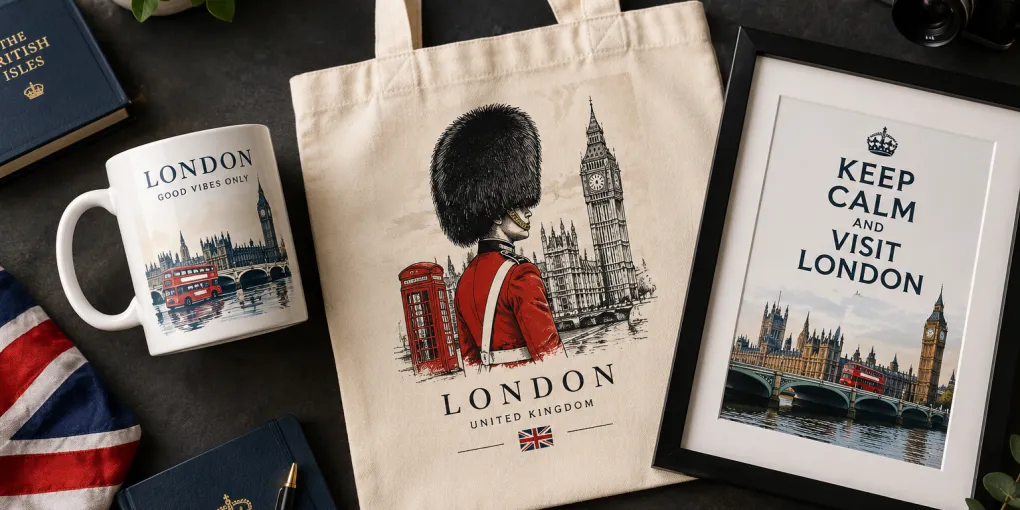
UK Print on Demand Niches: Personalized and Eco-Friendly Ideas
If you are shortlisting UK print on demand niches, the useful question is not “what sells?” but “what can I make, prove, and describe honestly, on my own, to a UK buyer?” That narrows things quickly. A solo seller with a print partner, a laptop and a few evenings a week cannot compete on catalog size with the big global stores, so the advantage has to come from specificity: UK occasions, UK places, UK humor, and product claims you can actually stand behind.
This guide covers three things: how UK-specific angles differ from generic global lists, which niche directions are worth testing, and how to score a niche on demand, personalization value, eco-friendly supplier evidence and intellectual property (IP) risk before you spend money on designs.
One thing up front: the demand evidence in this space is thin and mostly vendor-published. Trend reports from POD platforms and print agencies are directionally useful, not gospel. Treat every claim below as a hypothesis with a test attached.
For the general version of this process, see our guides on what makes a good print on demand niche and how to find a niche. This guide adds the UK-specific angles, the green-claims rules and a scoring method on top.
What makes UK print on demand niches different
Generic niche lists are written for a global audience and usually optimize for volume: dogs, nurses, fishing, gym. Those markets are real, but they are also crowded and largely price-driven. UK-specific angles work differently.
- Occasion language changes. “New home” cards and gifts cluster around completions, rentals and house moves. “Christening” sits alongside “baptism”. School leavers, exam results, and “last day of term” gifting have their own rhythm.
- Place is a gift category, not just a keyword. A mug for a specific town or county is bought as a gift, often by someone who has moved away or by a parent.
- Humor is regional and self-deprecating. Observational jokes about weather, trains, and garden centers land differently from the motivational one-liners that dominate US-facing POD catalogs.
- Buyers may be alert to green claims. The Competition and Markets Authority’s Green Claims Code is guidance on making environmental claims that are truthful, clear and substantiated (GOV.UK). It is a useful checklist, not proof that a product is sustainable, and it is aimed at businesses making environmental claims, including small sellers. Since the Digital Markets, Competition and Consumers Act 2024, the CMA can also fine businesses directly for misleading claims, with penalties of up to 10% of global turnover, so vague eco wording is a compliance risk and not just a trust issue.
Regional identity without stereotypes
Regional designs are one of the most obvious UK-specific angles, and one of the easiest to get wrong.
Use place as a starting point, not a punchline. “Whitby” on a tote bag is a place reference. “People from Whitby are all [trait]” is a stereotype, and it will date badly.
Practical guardrails:
- Test broad before narrow. “Yorkshire” has a far larger potential audience than a single village. Prove the concept at county or coast level, then go hyper-local if the broad version sells.
- Check official symbols. Council coats of arms, police and fire service crests, royal insignia and many club badges are protected or restricted in use. Do not assume a crest is fair game because it appears on Wikipedia.
- Do not reproduce or trace Ordnance Survey maps without checking the license. OS states that its mapping is subject to Crown copyright and licensing (Ordnance Survey licensing). A stylized coastline you draw yourself is a different thing from a reproduced map extract. If in doubt, draw from scratch or commission original artwork.
- Watch the sensitivity. Scottish, Welsh, Northern Irish and Cornish identity references carry history. If you are not from the area, get a second opinion before you build a collection around it.
Personalized gifts and British humor
Personalization is where a solo seller can compete, because the value is in the specificity rather than the scale.
The UK gift occasions worth structuring a collection around:
- Birthdays, particularly milestone ages (18, 21, 30, 40, 50, 60).
- Weddings and civil partnerships — dates, surnames, venue names.
- New home, including rentals and first flats.
- New babies and christenings.
- Christmas, especially family-role gifts (“Nanny”, “Grandad”, “Auntie”).
- Pet gifts and pet memorials.
- Retirement and leaving gifts, including “last day” and team gifts.
Humor needs more care than personalization. Original observational humor about commuting, weather, gardening, pub culture or the tip queue is fine. Copying an existing slogan is not. The “Keep Calm” formula is a well-documented example of how a slogan can end up in an EU trademark dispute, with small sellers caught in the middle. We’re not relying on it as legal guidance, and we wouldn’t build a collection on borrowed slogans. Being legally in the clear and being commercially viable are two different tests.
Eco-friendly expectations and limits
Eco-friendly is not a niche. It is a set of criteria you apply to a niche you have already chosen.
What a UK buyer might reasonably expect, and what you can check:
- Material composition. Organic cotton claims should be backed by a recognized standard such as GOTS; check the certificate and product scope on the GOTS site. “Eco cotton” with no certificate is a marketing phrase.
- Chemical safety. OEKO-TEX Standard 100 is a common textile certification; check what it actually covers on the OEKO-TEX site. It is not a blanket organic or carbon claim, so confirm the scope for the specific product.
- Packaging. Ask for specifics: plastic-free mailers, recycled content, paper tape, whether garments ship in polybags. Vague “eco packaging” statements are not enough.
- Fulfillment location and shipping distance. A UK-printed order shipped to a UK address avoids international air freight. That is a real difference. It does not make the product sustainable, and a UK fulfillment center does not guarantee lower impact if the blank garment was made on the other side of the world.
- Certification scope. A certificate covering one product line does not cover the whole catalog. Check which items it applies to.
Be honest about what you cannot verify. “Printed in the UK on GOTS-certified organic cotton, shipped in plastic-free packaging” is a claim you can support. “Sustainable clothing” is not.
UK niche angles worth testing
The four angles below are our own suggestions to test, not proven winners. Vendor trend posts such as My Needs Are Simple, Precision Proco, Teeinblue, and KR Customizer are a starting point for vocabulary and product categories. We have not audited their figures, and most come from companies that profit from POD growth, so do not use them for volume numbers.
Local pride and regional gift niches
The strongest version of this is a gift-for-someone-who-moved-away. Think: a print of a coastal town’s beach huts, a county outline with the buyer’s hometown marked, a mug for a London neighborhood.
What to check before designing:
- Does the place name have search volume on its own, separate from the product type?
- Is there an existing local gift shop or artist dominating the space? If so, what are they not doing (e.g. cheaper items, personalization, different product types)?
- Can you write the place name accurately? Misspelling a village is an instant credibility loss.
Avoid: official crests, reproduced maps, copied local slogans, and anything that treats a region as a set of character flaws.
Personalized family and milestone gifts
This is the highest-value angle and the highest-operational-risk one. Personalization means proofing, order-specific production, and higher customer service load.
Realistic solo-seller constraints:
- Proofing time. If you manually check each order, your ceiling is your evenings. Price accordingly or automate.
- Product fit. Names and dates work well on mugs, prints, aprons, cushions and baby bodysuits. They work badly on products where the print area is small or the finish is unpredictable.
- Error cost. A misspelled name is a remake. Build that into your margin.
- Lead time. Personalized items usually take longer. Be explicit about UK delivery windows, especially in November and December.
Pet memorials and new-home gifts are worth a look because the emotional driver is strong and the personalization is simple — one name, one date.
Occasion-led British humor
Observational humor sells as a gift because it signals shared experience. The category is strong; the execution is where people get caught.
- Write your own lines. Do not adapt a well-known slogan, song lyric, or film quote.
- Test on a small audience first — a handful of real people, not a focus group of your own enthusiasm.
- Be careful with sarcasm aimed at a group. Commuter humor works. Humor about a region’s poverty, accent or politics does not.
- Avoid “edgy” as a strategy. It narrows your buyer pool and increases the chance of a complaint, a takedown or a marketplace suspension.
Eco-friendly product angles
Treat this as a filter applied to the three angles above, not a standalone niche.
Workable starting points:
- Organic cotton t-shirts and baby wear where the certificate is specific and current.
- Recycled polyester or recycled cotton blends where the supplier states the recycled content percentage.
- Plastic-free or reduced-plastic packaging, confirmed in writing.
- Print-on-demand itself, which avoids the overproduction problem of bulk stock — a legitimate point, but not a sustainability certificate.
Where suppliers cannot evidence a claim, say nothing or describe the uncertainty. “Supplier states recycled packaging; I have not seen a certificate” is an honest listing. “Eco-friendly” is not.
How to score and validate a UK POD niche
Before you design anything, score the niche. This is not a rigorous model — it is a way to force yourself to write down what you actually know versus what you are assuming.
| Criterion | What you are checking | Score (1–5) |
|---|---|---|
| Demand evidence | Are people searching for the gift outcome, not just the design style? | |
| Personalization value | Does a name, date or place add genuine value? | |
| Supplier and eco feasibility | Can you source it with claims you can evidence? | |
| Production fit | Can you produce and proof it reliably as a solo seller? | |
| IP and cultural risk | Trademarks, crests, maps, copied slogans, stereotypes (reverse-scored: 5 = low risk) |
Total out of 25. There is no magic threshold. A pragmatic rule: anything scoring 2 or below on IP risk or production fit is a no regardless of total, because those are the two that cause real losses rather than slow sales.
Demand and search intent
Look for evidence that someone is trying to buy, not just browsing.
- Search the gift phrasing, not the design phrasing. “Personalised new home gift” tells you more than “new home illustration”.
- Check marketplace search suggestions and the number of competing listings, and note the date you checked. Listings counts move.
- Use Google Trends for seasonality, not absolute volume. A Christmas-heavy niche needs a plan for January.
- Look at what buyers complain about in reviews of competing products — that is usually the gap.
Do not invent numbers. If all you have is “this looked busy in November”, write that down as weak evidence and design a small test around it.
Personalization and product fit
Score higher where the personalization is simple and the product is forgiving.
- Simple: one name, one date, one place name.
- Forgiving: mugs, flat prints, aprons, tote bags.
- Fragile: multi-line layouts, photo uploads, tight registration, products with inconsistent print areas.
Reject niches where the personalization workflow needs a tool you do not have or a check you cannot do reliably at volume.
Eco-friendly supplier checks
Ask suppliers directly, in writing:
- What is the material composition, as a percentage?
- Which certifications apply to this specific product, and what is the certificate scope?
- What packaging is used, and is it plastic-free?
- Where is the item printed and dispatched from?
- What is the stated recycled content, if any?
Keep the answers. If a supplier’s public page says one thing and their support reply says another, the reply is the one you should rely on — and note the discrepancy.
IP, cultural, and regional risk
This is the section most solo sellers skip, and it is the one that costs the most.
- Trademarks: search the UK Intellectual Property Office’s trademark register (GOV.UK trademark search) for the phrase or brand name you want to use. Searching is free and takes minutes, but it is not a substitute for legal advice.
- Official symbols: crests, badges, royal insignia, military insignia, transport logos and sports club badges are usually protected. Assume you cannot use them.
- Maps: OS mapping is licensed and subject to Crown copyright; check the Ordnance Survey licensing page before reproducing or tracing any map. Draw your own stylized geography if in doubt.
- Quotes and lyrics: song lyrics and film quotes are copyrighted. Short phrases are sometimes too insubstantial to protect, but “sometimes” is not a business plan.
- Cultural sensitivity: get a second opinion before selling identity-based humor UK-wide or internationally.
If a design depends on a reference you cannot clear, drop the design, not the niche.
Turning a validated UK niche into a small, testable collection
Once a niche clears the scorecard, keep the first collection deliberately small. Five to eight designs across two or three product types is enough to learn from.
Design and listing checks
Write titles and tags around the buyer’s problem, occasion and UK search language — not around your design style.
- Lead with the gift outcome: who is it for, what is the occasion.
- Include UK spelling and terminology in listings: “personalised”, “mum”, “nanny”, “colour”.
- Use the marketplace structure properly. If you sell on Redbubble, the 15-tag hierarchy system is the right place to start rather than guessing at tags.
- Check your listing on mobile. It is worth testing how your listings look on a phone, but use your own analytics rather than assuming most gift browsing happens there.
Brand storytelling and IP safety
A short, specific brand story does more for a UK niche than a long one. Who the designs are for, why the place or occasion matters, and what you will and will not make.
The IP side matters more. Read the POD brand storytelling and IP takedown case study before you publish anything that leans on an existing reference. A takedown costs you the listing, the design time, and sometimes the storefront.
Visual identity and next-step workflows
Once the niche is chosen and validated, the design work becomes a visual consistency problem. The visual niche blueprint for a POD collection covers how to shape a coherent set of designs rather than a scatter of one-offs.
If your print partner is Printful and you are uploading a batch of designs, the bulk upload file optimization guide is the relevant next step. Keep it as a workflow reference, not a reason to change suppliers.
A short decision rule
Choose a UK print on demand niche by scoring it on demand evidence, personalization value, eco-friendly supplier feasibility, production fit and IP risk. Kill anything with high IP or production risk regardless of the total. Start with a small collection, write listings in the buyer’s language, and only make green claims you can evidence with a specific material, a named certification or a confirmed packaging detail.
Most of the uncertainty in this space comes from vendor marketing, not from your own testing. Your own sales data will be more honest than any trend report once you have a few weeks of real listings and traffic.
Sources and further reading
These are the trend and supplier sources referenced above. All are published by commercial POD or print businesses, so read them for category vocabulary and product examples rather than for market sizing.
- What’s trending and what is the future for print on demand — My Needs Are Simple
- Print on demand trends 2026 — Precision Proco
- Print on demand trends — Teeinblue
- Top print on demand trends for 2026 and beyond — KR Customizer
- Print on demand niches — Printful
This article contains no affiliate links, and none of the outbound links are monetized. It is general guidance, not legal advice: check current rules with the relevant UK authority or a qualified advisor before making trademark, copyright or environmental claims.
Frequently asked questions
Are eco-friendly print on demand products actually sustainable?
They can reduce some impacts, but no POD product is automatically sustainable. Check materials, packaging, certification scope, fulfillment location, shipping distance, and whether claims are specific. Treat vague eco language with caution.
What are good UK-specific POD niches for a solo seller?
Original regional pride designs, personalized family and milestone gifts, occasion-led British humor, and low-waste product angles can work. Validate demand, production fit, IP risk, and supplier availability before committing.
Do I need UK suppliers for UK print on demand niches?
Not necessarily. Local fulfillment can shorten shipping and may support a UK-focused promise, but product choice, quality, and verified claims matter. Compare options without assuming a UK location automatically means lower impact.
Can I use British regional stereotypes in designs?
Use care. Original observational humor is different from copying protected slogans or leaning on stereotypes. Check cultural sensitivity and trademarks, especially for official crests, maps, and symbols.
More from this series
Tools mentioned in this guide