Printful Analysis 2026: Fulfillment, Costs and Supplier Risk
Here’s a piece of advice you’ll find in a lot of print-on-demand guides, including some on this site’s own backlog: list your products on two suppliers so you’re not dependent on one company’s uptime, pricing, or quality control. Printful and Printify usually get named as the pair to use for exactly that reason — two competitors, so if one has a bad month, you lean on the other.
That advice needs an honest update. Since November 2024, Printful and Printify have effectively been the same company. This is a research-based analysis rather than a hands-on product test, built from official information, trade reporting and recurring user-feedback patterns.
The Merger Nobody Updated You On
Printful and Printify merged as equal partners in late 2024, and by December 2025 the combined parent rebranded as Fyul. As of 2026, both platforms still run separately day to day — separate dashboards, separate catalogs, separate pricing pages, no forced account migration. But “separate companies you can use to diversify supplier risk” is no longer an accurate description. They’re sister brands under one roof.
That doesn’t mean the diversification instinct was wrong — it means it needs a different pair. If supplier redundancy is the actual goal, pairing Printful with something genuinely outside the Fyul umbrella (Gelato and a handful of others get mentioned in this context) does what people originally wanted Printful+Printify to do.
What Still Actually Differs Between Them
Even under one owner, the two platforms haven’t been merged into one product, and the operational difference is real, not just branding. Printful runs its own in-house production facilities — it fulfills over a million items a month through factories it operates directly. Printify instead works through a network of 85-100+ third-party print partners it doesn’t own. That’s the practical distinction that still matters if you’re choosing between them today: Printful trades partner-network flexibility for tighter, in-house quality control; Printify trades that control for a wider range of print-partner pricing and locations to choose from.
What This Analysis Is Actually Based On
We didn’t run product through Printful ourselves for this piece. This is built from Printful’s own pricing and policy pages, merger reporting from trade press (PPAI, ASI, Bregal, and Printful’s own announcement), and a pass through hundreds of verified Shopify App Store and Capterra reviews — currently sitting around 4.8/5 across roughly 3,000 reviews — reading specifically for where the 1- and 2-star reviews cluster, since that’s where a review this size stops being marketing copy and starts being useful.
Where the Real Complaints Actually Are
The overwhelming majority of feedback describes consistent product quality and a smooth Shopify integration — that’s not manufactured, it shows up too often and too specifically to dismiss. But three genuine patterns surface in the lower-rated reviews, and they’re worth knowing before you commit a catalog to it:
Embroidery and complex jobs are where support gets slow. Multiple sellers, independently, describe multi-day waits specifically on embroidery mix-ups and misconfigured product options — one case involved a $540 order stuck for over a week. Printful’s own replies confirm the case-by-case pattern rather than deny it. Plain apparel and printed goods don’t show this pattern nearly as often.
Some sellers report fulfillment slowing down since the merger’s integration work began. This isn’t universal, but it’s specific enough — several reviews independently use the phrase “since expanding” or “since merging” to describe a decline in speed on jobs that used to be reliably fast. Whether this is temporary integration friction or a lasting shift isn’t something a review written today can settle either way.
Base prices sit above several competitors, which shows up in margin, not in quality. This is the most repeated complaint by far, and it’s really a margin-math problem more than a product problem: sellers consistently say the print quality justifies the price, but that the price itself makes it harder to stay profitable against lower-cost alternatives, especially before you’re at meaningful volume.
The Actual Cost, Beyond the “It’s Free” Headline
Printful’s Free plan really is $0/month — you only pay for products and shipping as orders come in, which is why it’s the reasonable default for anyone starting out. The optional Growth plan is $24.99/month and unlocks up to 33% off product pricing, plus discounts on branding and samples. It’s automatically waived once your trailing 12-month Printful sales cross $12,000, so it’s designed to pay for itself at real volume rather than stay a permanent cost.
The honest break-even, based on the discount structure, lands around 9-15 apparel orders a month — below that, the subscription discount doesn’t recover its own cost yet. That’s a five-minute calculation worth doing with your own numbers before upgrading just because a pricing page recommends it.
The Part of “In-House” Worth Understanding
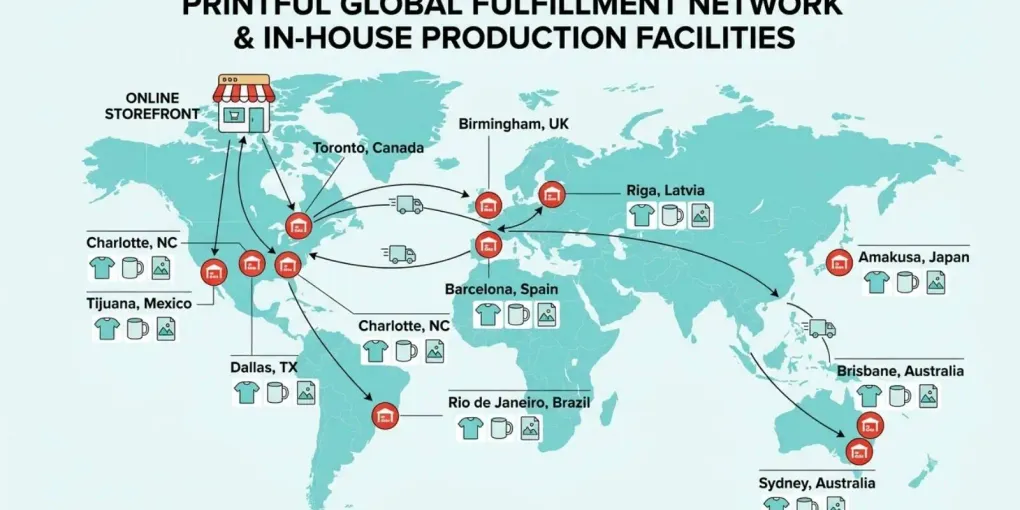
“In-house production” sounds like one factory, but Printful’s fulfillment network spans facilities across North America, Europe, and beyond — which is the actual reason a US customer and a UK customer can both get reasonably fast shipping without either order crossing an ocean. When a review complains about slow shipping, it’s worth checking which facility fulfilled the order and which product type it was, since turnaround varies more by product complexity (an embroidered hoodie takes longer than a printed mug) and by which facility got the job than by some blanket “Printful is slow” statement would suggest. That’s also part of what the post-merger integration work is reportedly reorganizing — the Latvia relocation to a larger Fyul facility, completing in Q1 2026, is explicitly framed as increasing that capacity rather than consolidating it down.
Who This Actually Fits
If quality consistency and in-house production control matter more to you than shaving a few dollars off base cost, Printful’s direct-fulfillment model is built for exactly that — and it’s the reason so much of the positive feedback specifically calls out reliability over price. If your margins are thin enough that every dollar of base cost matters and you’re comfortable with a print-partner network instead of in-house production, that’s a real trade-off worth weighing against Printify specifically, now that you know they share an owner rather than compete as strangers.
Since the account itself costs nothing to create, the lowest-risk way to judge any of this is to set up a free Printful account and price out your own actual catalog before committing to the Growth plan or building your storefront around it.
For the practical side of connecting Printful to your catalog, our MyDesigns to Printful workflow guide covers the API integration step by step. If you are working with hoodies specifically, our Printful hoodie print area guide explains how to keep graphics above the pocket line for clean DTG output.
If you’re building a workflow that pushes bulk designs into Printful automatically instead of uploading product by product, our MyDesigns to Printful workflow guide covers that pairing directly.
The Honest Verdict
Printful’s core product — in-house production, a genuinely free entry tier, and quality consistent enough that it’s the most repeated praise across thousands of independent reviews — holds up. The thing worth correcting isn’t the product; it’s the “these are two separate companies” assumption baked into a lot of standard POD advice, including advice you’ll find elsewhere on sites like this one. Know what you’re actually diversifying against before you build a two-supplier strategy around a pairing that stopped being two competitors over a year ago. If backup-supplier redundancy is genuinely the goal, that’s a five-minute research task worth doing before your next product launch, not an assumption worth carrying forward unchecked.
Some links in this article are affiliate links, including our Printful referral link. We don’t personally purchase or test every tool we cover — our recommendations are built from official documentation, pricing pages, and aggregated seller feedback, cross-checked for consistency before we write anything down.
Frequently asked questions
Are Printful and Printify still separate companies?
No, not since November 2024. They merged as equal partners, and by December 2025 the parent company rebranded as Fyul. Both storefronts, catalogs, and pricing still operate separately day-to-day, but they now share an owner.
Is Printful actually free to use?
Yes. The Free plan has no monthly fee — you only pay for products and shipping when an order comes in. The optional Growth plan is $24.99/month, and it's automatically waived once your trailing 12-month Printful sales hit $12,000.
Is the Growth plan worth it?
Only past a real volume threshold. The discounts (up to 33% off products) break even at roughly 9-15 apparel orders a month. Below that, the Free plan comes out ahead — check your own numbers before upgrading on a vendor's recommendation.
Are the complaints about slow fulfillment and print quality legitimate?
Some are, and they cluster in a specific place: complex jobs like embroidery, and the period right after the merger's operational integration began. The bulk-order t-shirt and mug experience most sellers report is still described as consistent.
More from this series
Tools mentioned in this guide