Surviving an IP Takedown & Rebuilding a POD Brand (2026)
It started with a single email.
“Notice of Intellectual Property Infringement Zenimax Media Inc.”
My heart sank. I had spent weeks designing a collection inspired by the rich, Nordic aesthetics of a certain popular fantasy RPG. The designs were good. The engagement was growing. And in one algorithmic sweep, my account was flagged, my listings were removed, and my entire print-on-demand strategy crumbled in front of me.
I could have quit. I could have cried about the unfairness of it all. Instead, I did something far more productive: I pivoted.
That crisis became the catalyst for building a real, defensible brand. Today, I want to share exactly how I transformed a catastrophic IP takedown into a thriving Dark Academia collection called The Arcane Archives and how you can do the same.
1. The Pivot: From Generic Gaming to a Secure, High-End Aesthetic
The first thing I realized was that my old strategy was doomed from the start. Creating designs inspired by popular franchises without proper licensing is like building a house on sand. It works until the tide comes in.
The Hard Reset
I made three drastic changes overnight:
-
The Name Change: I abandoned every generic, keyword-stuffed title. My store became The Arcane Archives a name that evoked mystery, scholarship, and timelessness rather than a specific game.
-
The Vocabulary Purge (“Anti-IP”): I banned a list of “radioactive” words from my entire catalog. Words like adventurer, inventory, RPG, D&D, tabletop, and obviously, any reference to Skyrim or Tamriel. If a search engine couldn’t associate my products with those protected franchises, I couldn’t get flagged again.
-
The Niche Lock-In: Instead of chasing generic “gaming” or “fantasy,” I pivoted completely to the Dark Academia and Gothic Macabre aesthetic movements. These are broad, non-trademarkable cultural trends with massive, passionate audiences in the US and UK markets.
The Lesson Learned
If you want to build a sustainable POD business, do not build it around someone else’s intellectual property. Build it around a visual world and a feeling. Dark Academia, Cottagecore, Witchcore, Steampunk these are safe, scalable, and deeply profitable.
2. The Birth of “The Relics”: 4 Designs That Defined My Brand
With the new visual direction locked in, I needed to create a collection that embodied the spirit of The Arcane Archives. I set a strict creative rule: no full animals. Everything had to feel like a fragment from a medieval cabinet of curiosities an object of study, a relic, a fragment of a forgotten story.
Here are the 4 flagship designs that emerged from that session:
The Archivist’s Rest
- The Visual: A skeletal scholar finding eternal rest atop a mountain of ancient, weathered grimoires.
- The Adjustment: I stripped the description of heavy keyword stuffing and rewrote it as a poetic, narrative piece centered on bibliophilia and the macabre. This is where I started applying the 80/20 rule 80% lore, 20% product description.
The Triple-Eyed Feline
- The Visual: A profile portrait of a black cat sporting a mystical third eye, with phases of the moon subtly etched into its fur.
- The Canva Text: “NINE LIVES, INFINITE SECRETS”
- Commercial Potential: Estimated at over 90%. Black cat lovers + occult aesthetics is a powerful, high-engagement intersection that performs incredibly well on Pinterest.
The Nautilus Compass
- The Visual: A Nautilus shell (respecting the golden ratio) fused with an antique brass compass. Mechanical tentacles emerge from it, wielding a scribe’s quill and a surgical scalpel.
- The Canva Text: “NAVIGATING THE UNKNOWN”
- Analysis: The crown jewel of the collection. It blends vintage natural history, subtle steampunk, and intellectual exploration a triple-threat of aesthetic appeal.
The Lantern Moth
- The Visual: A Death’s Head Hawkmoth perched atop a lit apothecary lantern, surrounded by alchemical runes and constellation lines.
- Strategy: A highly symmetrical design, perfect for generating high engagement (Saves) on Pinterest. Symmetry performs exceptionally well in grid-based visual search engines.
3. The Artistic Rules That Make It All Cohesive
A collection isn’t a collection without strict visual constraints. Here are the hard rules I now apply to every single design I produce:
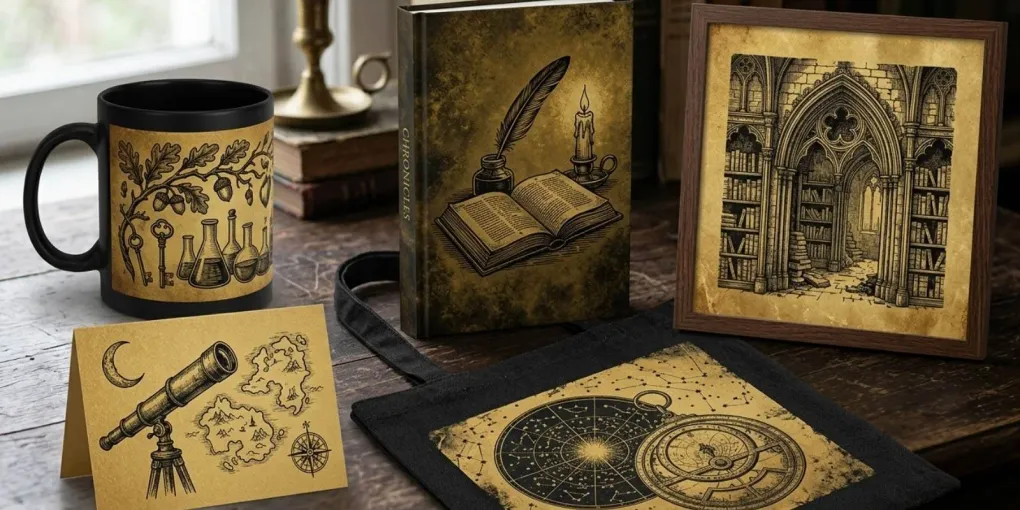
- Style Constraint: 17th-century woodcut / engraving style. Heavy cross-hatching, no gradients.
- Color Palette: Deep jet-black ink on either pure white or antique unbleached paper. Occasionally a metallic antique gold accent for premium products.
- Typography (If Used): Exclusive use of historical serif fonts primarily IM Fell English SC and EB Garamond. No modern sans-serifs.
- Textile Placement: For all apparel (hoodies, t-shirts), the design must be reduced in size and centered strictly on the upper chest. This avoids overlap with pockets, seams, or hoodie pouches, ensuring a clean, premium retail look.
Why such strict rules? Because constraints breed creativity. They also make my brand instantly recognizable. A customer who sees one of my pins on Pinterest should immediately recognize a second one.
4. The Technical Lesson: Metadata Is Part of the Brand
The pivot wasn’t just visual, it also forced me to rethink how I structure Redbubble tags and metadata, since sloppy keyword stuffing was part of what put my old catalog at risk in the first place. I won’t repeat the full tag-by-tag mechanics here since I’ve already documented that system in a dedicated guide: The Redbubble Tag Pivot Strategy. What matters for this article is the principle: your metadata should read like an extension of your brand’s world, not a keyword dump. Every tag on The Arcane Archives reinforces the Dark Academia aesthetic first, product context second.
5. The Ecosystem: Automating Pinterest & Tumblr
Creating great designs is only half the battle. You need traffic. I’ve built a simple, automated ecosystem that feeds my products to the right audiences:
- Pinterest (Visual Search): As I detailed in my guides on the Pinterest Algorithm for POD and Pinterest SEO & AI Mockups, I post 6 pins per day targeted at the US/UK evening windows (9 PM / 11 PM EST). I use the “cloning strategy” to create fresh pins from new angles without triggering Pinterest’s sandbox.
- Tumblr (Micro-Blogging): I run a blog called The Arcane Curator. Instead of shouting “Buy my shirt,” I post lore behind each design. 80% of the post is a mysterious story or historical “fact” about the creature or relic. 20% is a discreet link to the product. This builds a following of passionate fans who genuinely care about the world I’m building.
6. The Tools That Make This Workflow Possible
I can’t manually create 6 pins, write 3 lore posts, and manage tags for 50 products every week. This workflow relies on a few key tools that I’ve integrated into a single pipeline.
Here’s my stack:
- MyDesigns: I use this to automate my bulk uploads. Once I have a design file ready, I can push it across multiple platforms with standardized metadata and tags.
- Printful: This handles all my fulfillment. The integration with MyDesigns ensures that when a product sells, it’s automatically produced and shipped without manual intervention.
- Creative Fabrica: My go-to source for base textures, vintage fonts, and vector assets that feed into my AI mockup generation process.
- Bulk Mockup: I use this Photoshop plugin to mass-generate lifestyle mockups. Instead of spending 30 minutes on a single flat-lay, I can generate 100 variations in minutes.
- Podly: Before I even start designing, I use Podly to validate my niche. It tells me what’s already selling, what the search volume is, and whether the market is saturated.
This integrated pipeline saves me over 20 hours a week and ensures absolute consistency across all my touchpoints.
Conclusion: The Crisis That Forged My Brand
Looking back, that Zenimax takedown email was the best thing that ever happened to my print-on-demand business. It forced me to stop chasing trends and start building a real brand.
The Arcane Archives isn’t just a collection of t-shirts. It’s a cohesive, visually recognizable world. It has strict artistic rules, a clear target audience, and a technical workflow that scales effortlessly.
If you’re building a POD business, don’t be a generalist. Don’t build on borrowed IP. Find a specific aesthetic, create strict visual constraints, tell compelling stories, and automate the technical grind. You’ll build something that lasts far longer than any viral trend.
Disclosure: Some of the links in this article are affiliate links. This means I may earn a small commission if you make a purchase, at no extra cost to you. I only recommend tools I personally use and trust.
Frequently asked questions
How do I avoid IP takedowns on Redbubble?
Avoid trademarked terms like Skyrim, D&D, or RPG in titles, tags, and descriptions. Build a unique visual universe around broad aesthetic movements like Dark Academia or Gothic Macabre instead of specific franchises.
Do I need a new store name after an IP takedown?
Not always, but a name tied to the franchise that got you flagged should go. Pick something that evokes your new aesthetic world instead of a specific IP, so future collections can grow under it without risk.
Can I really build a brand around a niche like Dark Academia?
Yes. Highly aesthetic, defined niches build instant emotional connection, higher conversion rates, and lower competition compared to generic t-shirt stores targeting everyone.
How do you create a cohesive visual identity for a POD brand?
Define strict artistic constraints: limit your color palette (e.g., black ink on antique gold), choose a specific style (e.g., 17th-century woodcut), and lock your typography (e.g., IM Fell English). Apply these rules to every design.
More from this series