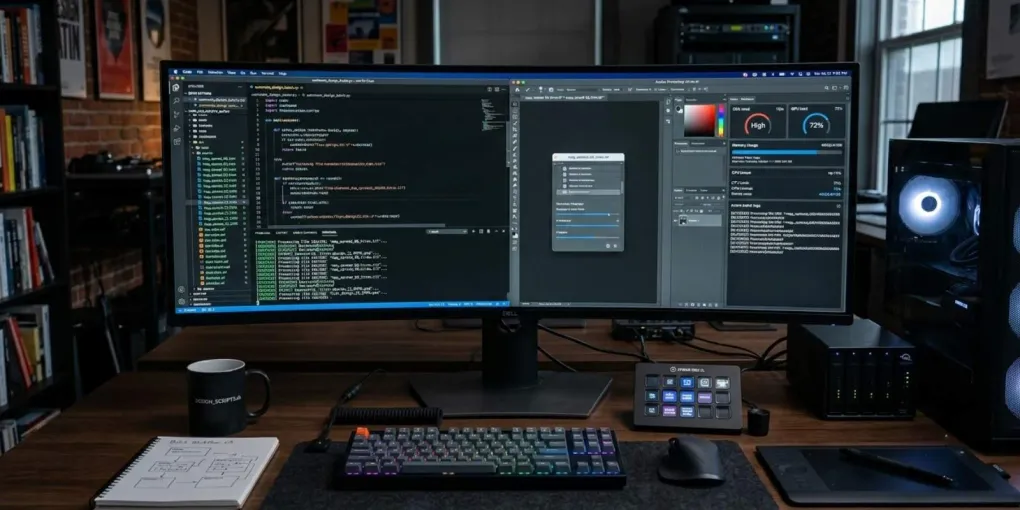
Local vs Cloud POD Image Automation: Choose the Right Workflow
For POD image bundles, local processing is not automatically better than cloud processing. Choose local when you need direct control of Photoshop-based templates, can maintain a workstation and want to keep the rendering step close to your source files. Choose cloud when shared access, browser-based collaboration or marketplace-connected publishing removes more work than it adds. Choose a hybrid workflow when rendering and distribution are genuinely different jobs.
The practical question is not “which model wins?” It is: where should each asset move, who needs access, what does it cost to run and recover, and what breaks if a connection, account or workstation is unavailable? This guide turns that question into a repeatable decision rather than a blanket recommendation.
Start With the Job, Not the Tool
Separate the POD workflow into stages before choosing where it runs. A typical collection has at least four:
- Create and revise the source artwork and editable template.
- Render product mockups and export the required variants.
- Review buyer-facing images, descriptions and product-to-asset mapping.
- Publish and monitor listing data across the channels you use.
Local and cloud tools can both support parts of this sequence. A local Photoshop workflow is often a sensible fit for a template that depends on your own layers, Smart Objects, fonts and image files. A cloud platform can be a sensible fit for collaboration, shared access and a publishing process that must interact with online marketplaces. The mistake is asking one tool to be equally good at every stage.
| Decision area | Local workflow | Cloud workflow | Hybrid workflow |
|---|---|---|---|
| Template control | You retain direct control of local PSD files, fonts, actions and export settings. | Control is limited to what the service exposes in its editor or templates. | Keep master templates local; share approved outputs and records online. |
| Collaboration | You must create your own sharing, permissions and review process. | Can simplify shared access, comments and approvals when the service supports them. | Use cloud access for review and workflow status, while source files remain controlled. |
| Connectivity | A self-contained local render may continue without a connection. | Upload, processing and publication normally depend on the provider and connection. | Local rendering can continue; sync and publication wait for connectivity. |
| Cost structure | Hardware, software, electricity, backups and your maintenance time. | Subscription, usage, storage, transfer and collaboration costs depending on the service. | Costs both types of capability, but avoids forcing one tool to do every task. |
| Continuity risk | Device failure, theft or ransomware can block production without tested backups. | Account access, provider availability and configuration can block access to the workflow. | Reduces single-point dependence only if the data, access and recovery plan are documented. |
What Local Processing Can—and Cannot—Control
Local processing gives you control over the files and settings already on your workstation. If you have built an apparel template around specific Photoshop layers, masks, fonts and placement rules, processing it locally lets you inspect the exact source and export it according to your own settings. That can be valuable for a carefully maintained mockup library; it does not prove that every local export is higher quality than every cloud export.
Do not confuse screen-resolution labels with output quality. The useful checks are the pixel dimensions, colour profile, compression settings, crop and how the resulting image appears in the actual buyer-facing channel. Use the separate Etsy listing-image QA checklist before publishing a large set of mockups. It covers the marketplace image checks; this article covers the architecture decision behind the rendering workflow.
Local control also comes with operational ownership. Adobe’s current Windows requirements list 8 GB RAM as a minimum and 16 GB or more as recommended, together with a fast internal SSD and a separate internal scratch disk for better performance.1 That is a starting point for installing Photoshop, not evidence that a fixed RAM level will process a particular number of mockups. Benchmark your actual PSD template, actions and file sizes on your own machine before committing to a full batch.
Price the Workflow With a Comparable Total Cost
Avoid claims such as “local becomes cheaper after a set month” unless you have the current prices, usage and hardware assumptions for one specific case. SaaS plans, plugin pricing, storage, hardware depreciation and your production volume change too often for a generic break-even claim to remain reliable.
Use the same period—six or twelve months, for example—and list every cost that applies to your workflow:
| Local cost to include | Cloud cost to include |
|---|---|
| Workstation purchase or depreciation | Subscription or per-use charges |
| Required desktop software and plugins | Storage, transfer or export charges where applicable |
| Electricity, repairs and replacement parts | Required add-ons, user seats or upgraded tiers |
| Backup media or backup service | Migration, backup and recovery controls you still need |
| Time spent maintaining templates, updates and access | Time spent uploading, reviewing and managing permissions |
Then compare the numbers against the work that each model removes. A cloud plan can be worthwhile if it eliminates meaningful coordination or publishing work. A local setup can be worthwhile if you already own the equipment and repeatedly render complex, controlled templates. Neither conclusion follows from mockup volume alone.
Treat Local Storage and Cloud Accounts as Security Responsibilities
“Local” does not mean private, safe or backed up by default. The U.S. Cybersecurity and Infrastructure Security Agency (CISA) warns that data on a device can be lost through failure, theft or compromise. It recommends encryption and backups to a secure external drive or a properly vetted cloud service; it also advises not leaving an external backup drive connected when it is not being used.2
For a local POD workstation, document these minimum controls before you scale: device access, encrypted storage where appropriate, the location of backup copies, the recovery process and a test that proves you can restore a source file and its exports. If a freelancer or team member needs access, record who can open the source files and who can approve an export.
Cloud storage moves some infrastructure work to the provider, but it does not remove your responsibility for account security, permissions, configuration and data handling. AWS describes this as a shared-responsibility model: the provider protects the underlying infrastructure while the customer remains responsible for controls that vary by service, including data and configuration.3 Treat this as a general reminder to read the documentation and terms of every cloud tool you use; it is not a claim that every provider offers the same protections.
A Hybrid Workflow Is Often the Most Honest Answer
For many POD teams, the cleanest split is straightforward:
- Keep editable source artwork and production templates in the asset library where versioning and rights are controlled.
- Render controlled mockups on the workstation if the template requires it.
- Register each approved export with its asset ID, version and product variant.
- Use a cloud layer only where it adds real value: remote review, shared status, catalogue data or channel publication.
The practical DAM asset-registry workflow explains how to track those IDs, versions, rights and publication states. If you use Photoshop-based mockup automation, the BulkMockup workflow guide covers the local template setup; treat it as one production component, not a complete operating system.
Test the Decision With Your Own Collection
Before changing tools or committing to a plan, run a small pilot using one representative design, one complex template and a realistic set of variants. Record the following rather than relying on a generic benchmark:
| Measure | What to record |
|---|---|
| Output integrity | Template placement, dimensions, colour and visible artefacts in the export |
| Cycle time | Preparation, rendering, review, upload and correction time—not only render time |
| Cost inputs | Software, storage, hardware allocation and any paid usage attached to the pilot |
| Recovery | Can you locate and restore the source, template, export and associated record? |
| Collaboration | Can the right person review and approve the asset without gaining unnecessary access? |
Use the evidence from that pilot to decide whether a local, cloud or hybrid workflow reduces your actual bottleneck. For the next stage of catalogue growth, connect the choice to your POD scaling workflow rather than treating image generation as an isolated task.
The Practical Limitation
Neither model guarantees faster launches, higher conversion rates or lower lifetime costs. Local rendering requires maintained hardware, software and backups. Cloud services require a connection, careful account controls and an understanding of the provider’s limits. A hybrid design adds integration work. The better option is the one whose responsibilities you can document, test and sustain for the particular templates, team and sales channels you operate.
Sources
Frequently asked questions
How much RAM does a local Photoshop mockup workflow need?
Adobe lists 8 GB of RAM as a minimum and 16 GB or more as recommended for Photoshop on Windows. The right capacity for a mockup batch depends on the PSD files, actions, fonts, scratch disk, scripts and other applications, so test your own template rather than using a universal mockup-count threshold.
Is local image automation always cheaper than cloud tools?
No. Compare total cost over the same period: hardware, Photoshop and plugin fees, electricity, backups and maintenance for local work; subscription, per-use, storage, transfer and collaboration costs for cloud work. The lower-cost option depends on your existing hardware, output volume and which features you actually use.
Can I combine local rendering with cloud publishing?
Yes. A hybrid workflow can keep editable PSD templates and high-resolution production exports on a controlled workstation while using a cloud tool for shared asset access, approvals, listing data or publication. Define where the source of truth lives and how completed assets are backed up before connecting the stages.
Can local processing continue if my internet connection fails?
A rendering step can continue during an outage only when its software, licence checks, templates, fonts and input files are already available locally and that step does not call a remote service. Sync, cloud backup and marketplace publishing will wait for connectivity. Local storage still needs tested backups and device protection.
More from this series
Tools mentioned in this guide